
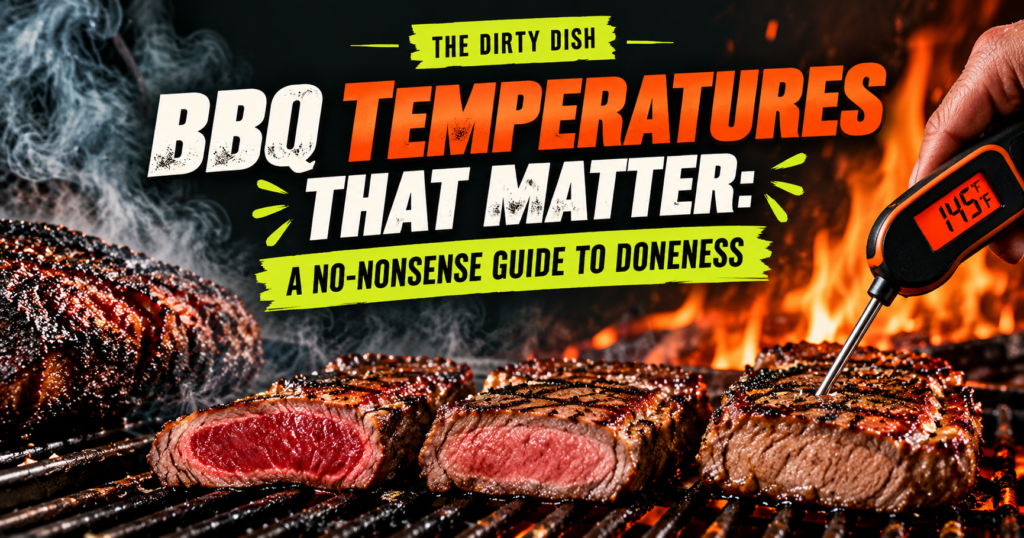
The grill’s built-in temperature dial is useful. It is not a mind reader. It tells you something about the air near the sensor, not necessarily what is happening at the center of a chicken thigh or burger. For a safer, better cook, learn to use two numbers: the temperature inside the cooker and the temperature inside the food.
That second number matters more than beautiful grill marks or juices that “look clear.” Color isn’t a reliable way to confirm safe cooking.
Keep the safe minimums close
These are U.S. Department of Agriculture minimums, measured with a food thermometer:
| Food | Minimum internal temperature |
|---|---|
| Chicken, turkey, duck, and other poultry, including ground poultry | 165°F |
| Ground beef, pork, lamb, or veal | 160°F |
| Whole beef, pork, lamb, and veal steaks, chops, and roasts | 145°F, then rest at least 3 minutes |
| Fish | 145°F |
| Leftovers and casseroles | 165°F |
| Egg dishes, including frittatas | 160°F |
For whole eggs, cook until whites and yolks are firm if following the standard food-safety recommendation. As always, use a reliable instant-read thermometer rather than assuming something is done because the timer beeped.
Cooking temperature is not the same as finishing temperature
Grill or smoker temperature describes the environment surrounding the food. Internal temperature tells you what’s happening in the food itself. Low-and-slow barbecue may operate at 225–300°F in the smoker, according to USDA hot-smoking guidance, but a shoulder, brisket, or rack of ribs needs its own internal temperature check.
A pork shoulder often becomes tender enough to shred at temperatures higher than the USDA food-safety minimum of 145°F plus three minutes. That’s about texture and rendered connective tissue, not a second federal safety threshold. If it’s cooked safely but still feels tough, the solution for pulled pork may be more time at a controlled cooking temperature.
Where to place the probe
For a steak or roast, aim at the center of the thickest part, avoiding bone, fat pockets, and gristle. For a thin burger, insert from the side toward the center. For poultry, check the thickest breast and innermost thigh and wing regions as appropriate, without touching bone. Test multiple places in a large roast.
Don’t leave an ordinary instant-read thermometer inside a hot smoker; only leave-in probes rated for that use belong there. Clean the probe between raw and cooked food and between different meats.
Carryover and the rest
Food can continue warming after it comes off the heat. That’s why a properly planned rest improves consistency, but do not treat carryover as a substitute for confirming the required safe minimum. The USDA’s three-minute rest for whole beef, pork, lamb, and veal steaks, chops, and roasts is part of that minimum recommendation.
Resting also reduces the rush of juices when you cut into a hot roast. The bigger the cut, the more helpful a thoughtful rest can be. Keep food out of unsafe holding temperatures while you’re setting the table.
A simple temperature workflow
- Preheat the cooker and verify its working temperature near the cooking area.
- Season the protein. Remember that sugar-containing rubs can brown before the center is safely done.
- Start the food in the correct zone for its thickness; use indirect heat for thicker or delicate cuts.
- Begin checking before the expected finish time.
- Confirm the thickest point has reached the required temperature, apply the proper rest where indicated, then serve.
When you have guests, keep cooked hot food at 140°F or above and cold food at 40°F or below. Refrigerate perishables within two hours, or one hour if the ambient temperature is above 90°F.
Seasoning suggestions for every thermometer reading
Bird Dog works with roasted or grilled poultry; Prime Cut suits whole beef cuts; Shore Thing complements fish and shrimp; Original Recipe is a reliable all-rounder. Flavor should be bold. Cooking safety shouldn’t require guesswork.
Reference: USDA safe minimum internal temperature chart and USDA food thermometer guidance.