
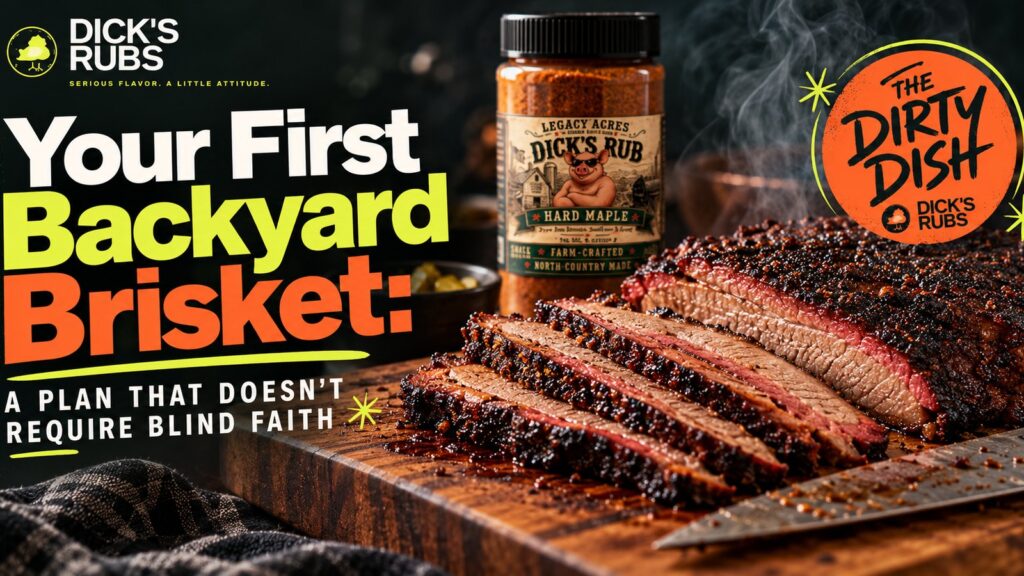
Brisket is the cut that convinces otherwise reasonable adults to wake up before sunrise and stare at a thermometer for half a day. It’s also delicious when handled with patience. Before you commit, know what you’re trying to do: cook a big, tough beef cut until the connective tissue softens and slices are tender without drying out.
A brisket is not a quick steak, and a single exact cook time won’t save you. Thickness, fat, cooker temperature, and the size of the meat all affect the finish.
Choose a manageable brisket
For a first attempt, consider a smaller whole brisket or an adequately marbled flat that fits your cooker comfortably. A very lean flat can dry more readily than the fattier point. Trim hard surface fat and ragged thin edges if needed, but don’t remove every trace of the fat that helps protect the meat.
Buy a reliable probe thermometer and a separate cooker thermometer before you worry about fancy wrapping paper. If your smoker’s temperature swings wildly, learn its behavior on a shorter cook first.
Build your flavor foundation
Start with a dry surface. Apply an even layer of Dick’s Prime Cut, whose coarse black pepper, garlic, smoked paprika, coffee, and chipotle suit beef especially well. You can use Camp Fire for a smokier coffee profile, but avoid piling on both until you’ve tasted how concentrated the blends are.
Since Prime Cut includes salt, start conservatively; more rub isn’t always better. Let the meat rest refrigerated while you prepare the cooker. You don’t need to soak it in a dozen ingredients overnight.
Manage the fire, not the clock
For home hot-smoking, the USDA advises maintaining a smoker between 225°F and 300°F. Many backyard cooks choose a stable operating point within that range. Cook over indirect heat with a small amount of suitable food-grade hardwood smoke. Oak is a dependable starting choice with beef; too much wood can make the bark bitter.
Keep the lid closed when possible and log major temperature changes. Repeatedly opening the smoker to admire the brisket can prolong the cook. Use the probe as a guide, but don’t interpret the temperature as a countdown timer.
Understand the stall
A large cut can sit near the same internal temperature for what feels like forever. Evaporative cooling from moisture on the surface is a major reason. You can ride it out, or wrap the brisket in food-safe butcher paper or foil once the exterior has developed good color. Wrapping can speed the cook but softens the bark. Either approach is a tradeoff, not a moral test.
Brisket is safely cooked at a lower internal temperature than the temperature at which it becomes pleasant to slice. Many pitmasters assess tenderness in the higher ranges near where connective tissue has softened, but probe tenderness, not a magic number, is the deciding cue for texture. Confirm food safety throughout with a calibrated thermometer.
Rest before slicing
When it is tender, give the brisket time to settle in a safe, covered rest. Slice across the grain. The point and flat have different grain directions; take a moment to find them instead of carving randomly across the board. Serve with crisp potatoes, roasted vegetables, or simple slaw.
For a North Country plate, try roasted Masters Potatoes from Legacy Acres when available, seasoned with a light shake of Side Hustle. That garlic-dill side cuts through the richness of beef nicely.
Your first-cook checklist
- Trim only what needs trimming; keep the shape even.
- Season with Prime Cut and refrigerate until cooking.
- Stabilize a safe hot-smoking temperature in the 225–300°F range.
- Use one thermometer for the smoker and one for the meat.
- Wrap only if it helps your preferred bark and timeline.
- Check for tenderness and food safety before removing.
- Rest safely, then slice across the grain.
The honest expectation
Your first brisket might not be competition-perfect. It can still make a wonderful meal. A great brisket takes practice, but the fundamentals are refreshingly boring: steady heat, good seasoning, smoke in moderation, and not panicking halfway through.
References: USDA: Smoking Meat and Poultry and USDA: Safe Minimum Temperature Chart.