
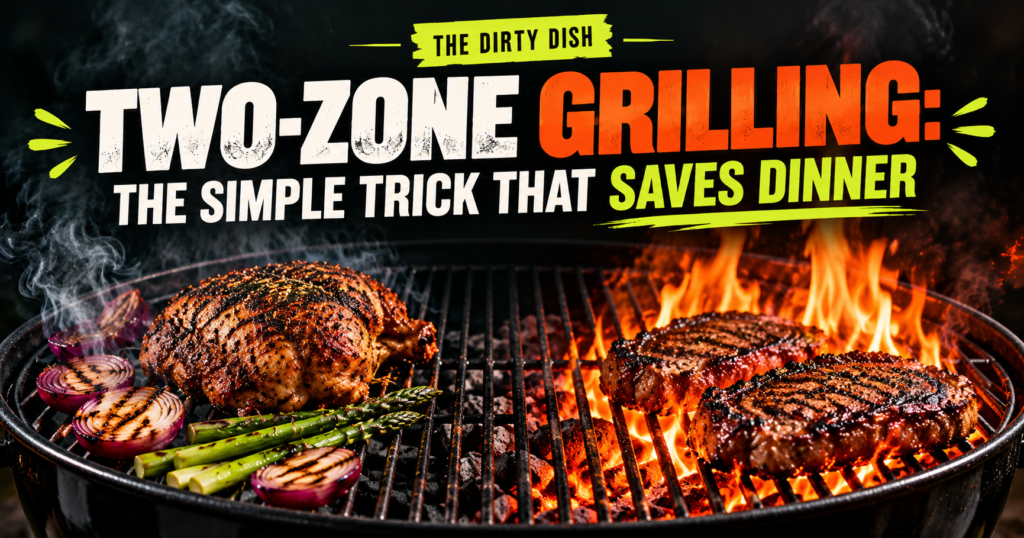
A grilling secret: some of the best food happens when you move it away from the fire. If you’ve ever had chicken that’s charcoal-black outside and suspiciously pink inside, the problem probably wasn’t the seasoning. The problem was trying to cook everything over the hottest part of the grill.
Two-zone grilling divides your cooker into a hot zone for searing and a cooler zone for indirect cooking. It’s the backyard equivalent of having both a stovetop burner and an oven, except the neighbors can smell what you’re making.
How to set up two zones on gas
Preheat according to your grill manufacturer’s instructions. With multiple burners, leave one side on and turn the other side off or much lower. You want an obvious hot area and a covered indirect area. A grill-safe thermometer near the cooking grate gives more useful information than relying entirely on the lid thermometer.
Put the thick cut on the cooler side first. Close the lid and cook until it’s approaching its intended finished temperature, then move it over the hot burners for color. If fat causes a flare-up, move the food back to the cooler side until the flames settle. Never spray water into a grease fire.
How to set up two zones on charcoal
Bank the coals on one side of the grill, leaving the other side without coals beneath it. Put the grate in place and preheat. The side over the coals is for direct heat; the opposite side is your indirect zone. Leave vents open enough to maintain stable combustion and adjust according to the cooker manual.
For ribs or a larger piece of meat, put a suitable drip pan under the cooler side. Don’t position the food directly above blazing coals unless you’re doing a brief sear.
Three easy ways to use it
Bone-in chicken thighs: Start skin-up on the indirect side. Cook with the lid closed until the center is safely approaching doneness; finish briefly skin-down over direct heat for color. Poultry must reach 165°F in its thickest part.
Thick pork chops: Start indirectly to cook the center more evenly, then sear on the hot side. The USDA safe minimum is 145°F plus a three-minute rest for whole pork chops. A thin chop may go directly over heat instead.
Potatoes: Foil-wrapped whole potatoes and covered potato packets can begin over indirect heat; finish opened or on a grill-safe tray for crisp edges. A side of Masters Potatoes makes this a natural farm stand pairing when in season.
Where the seasoning fits
Rub your food before it goes on the grill, but remember that some Dick’s Rubs blends include sugar. Original Recipe, Hard Maple, and Hot Rod can color quickly over intense heat. That doesn’t mean avoiding a good sear. It means controlling the timing and moving food when the surface is browned enough.
For a big smoky steak, Prime Cut or Camp Fire gives you savory pepper and coffee notes without depending on a sugary exterior. For chicken, Bird Dog is a strong choice thanks to its herb-and-lemon profile.
Do you have to flip constantly?
Not necessarily. Flip when it helps you control browning and cooking. With a two-zone setup, you can move food repeatedly as the fire shifts. There’s no medal for refusing to use the cool side. Close the lid for indirect cooking and open it as needed to move or monitor food safely.
A thermometer is nonnegotiable. Don’t judge a chicken thigh by the color of its juices or a burger by whether it’s brown in the center. USDA recommends 160°F for ground meat and 165°F for poultry.
The easiest first test
Try bone-in chicken thighs seasoned with Bird Dog on one half of the grill, leaving the other half hotter for a quick finish. You’ll see how much easier it is to get tender, properly cooked chicken without burning the skin. Once you learn the technique, ribs, burgers, chops, and vegetable sides all get more predictable.
The two-zone method won’t make you the grill champion overnight. But it will let you walk away from the grill for a minute without dinner immediately turning into a lesson in regret.
Food-safety reference: USDA safe minimum temperatures.